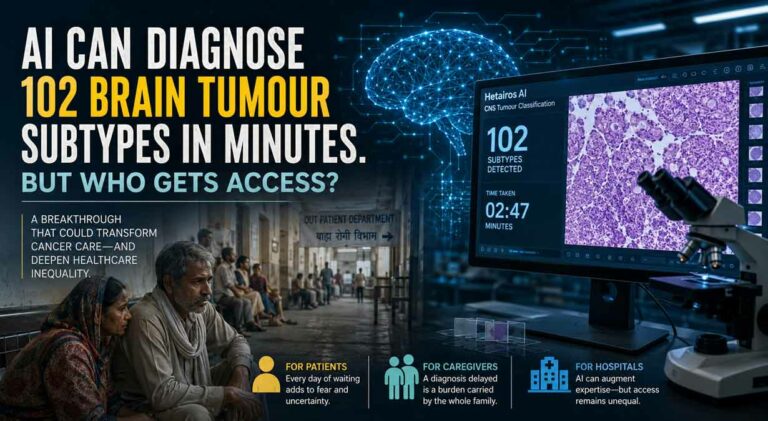
Cancer. A word so dreaded that it instantly sends a chill down anyone’s spine. Especially for patients waiting on a diagnosis. For them, every day drags on, weighed down by worry and endless what-ifs.
But what if that stretch of uncertainty gets reduced from days or weeks to just a few minutes? Well, that’s now possible, or at least there is hope, according to researchers at the German Cancer Research Centre (DKFZ), Heidelberg University’s Medical Faculty, and Heidelberg University Hospital. They have developed an AI tool that can analyse standard pathology slides and identify 102 types of brain and central nervous system tumours. [1]
Speeding up diagnosis can be a game-changer when it comes to cancer treatment — decisions get made faster, treatment can start sooner, and anxiety doesn’t get quite as much time to fester.
But there’s a bigger question running under all the excitement. As AI starts to make its way into hospitals and clinics, who really benefits? Will this technology close the gap, bringing expert-level care into the hands of folks who don’t have access now? Or will it just end up reinforcing old divides, funnelling more resources and advantages into the same hospitals that already have plenty?
The answer may determine whether AI narrows healthcare inequalities—or widens them.
Why this breakthrough matters
The newly developed AI tool, called Hetairos, demonstrated the ability to classify 102 CNS tumour subtypes using standard histopathological images. [1][2] Traditionally, diagnosing such tumours often requires specialised molecular testing, advanced laboratory infrastructure and the expertise of trained neuropathologists.
By identifying subtle patterns in routine pathology slides, AI systems such as Hetairos could help clinicians arrive at diagnoses more efficiently. In oncology, where treatment strategies often depend on precise tumour classification, shortening diagnostic timelines may have meaningful implications for clinical decision-making. [3]
However, the significance of this breakthrough extends beyond the laboratory. It lies in how such technologies reshape the experiences of patients, caregivers and healthcare institutions.
For patients, time is never just time
A cancer diagnosis rarely affects only the body. It disrupts routines, relationships, careers and future plans. For patients, the period between tests and receiving results is often marked by uncertainty. Questions linger. Treatment decisions remain on hold. The mind gravitates towards worst-case scenarios. Every additional day spent waiting can intensify emotional distress.
An AI system that enables faster diagnoses cannot eliminate the fear associated with serious illnesses. But it may help reduce one of healthcare’s most difficult burdens: uncertainty.
Earlier diagnostic clarity could enable patients to begin discussions about treatment options sooner, seek second opinions when necessary, and regain a sense of control during an otherwise overwhelming period.
The invisible burden carried by caregivers
Cancer rarely impacts individuals in isolation. Family members and caregivers often shoulder significant emotional, logistical and financial responsibilities while navigating uncertain healthcare journeys. They coordinate appointments, arrange transportation, manage employment obligations and provide emotional support.
In India, where family members frequently assume caregiving roles, these responsibilities can become particularly demanding. For caregivers, prolonged diagnostic timelines often translate into extended periods of anxiety and planning without answers.
Faster diagnostic pathways could provide families with greater clarity, allowing them to organise treatment plans, finances and support systems sooner. The benefits of timely diagnosis, therefore, extend beyond patients themselves. They ripple through entire households.
Hospitals are under pressure to do more with less
Healthcare institutions across the world continue to grapple with increasing patient volumes, workforce shortages and growing demands for specialised expertise. [4] In pathology, particularly within highly specialised areas such as neuropathology, trained professionals remain in short supply. Artificial intelligence is increasingly viewed not as a replacement for clinicians, but as a tool that augments existing capabilities. [5]
Several organisations have already begun moving in this direction. Companies such as PathAI and Paige have developed AI-powered pathology platforms designed to support diagnostic workflows. [6][7] Tempus, a precision medicine company focused on oncology, has integrated AI into pathology and clinical decision-support systems to derive insights from clinical and molecular data. [8]
For hospitals, the appeal is understandable. If implemented responsibly, AI could help optimise workflows, support overburdened specialists and improve efficiency without compromising the quality of care. However, the ability to adopt such technologies may itself become a differentiating factor.
The ideal scenario versus the reality on the ground
In an ideal world, breakthroughs such as Hetairos would quickly become available across healthcare systems. A patient visiting a district hospital would benefit from the same diagnostic support available at a leading cancer centre. AI would amplify scarce expertise, reduce waiting periods and help level the playing field.
The reality, though, is often more complicated. India’s healthcare system continues to face challenges related to infrastructure, workforce shortages and uneven access to specialised services. [4] Government hospitals, despite serving millions of patients annually, frequently operate under significant resource constraints. High patient volumes, limited personnel and administrative pressures can affect the speed and consistency of care delivery.
Families often navigate multiple consultations, referrals and extensive travel while seeking specialised treatment. Insurance introduces another layer of complexity. Patients and caregivers frequently encounter delays due to pre-authorisations, claim approvals, documentation requirements, and policy limitations. While insurers play a critical role in financing healthcare, administrative friction can contribute to already stressful experiences.
In such an environment, there is a legitimate concern that AI-powered diagnostics may initially be concentrated within institutions that already possess stronger digital infrastructure and financial resources. The very technology capable of democratising expertise could, paradoxically, become accessible first to those who already enjoy better healthcare access.
Can the poor actually benefit from healthcare AI?
The answer depends less on the technology itself and more on the systems through which it is deployed. If AI tools are integrated into public healthcare infrastructure and supported through targeted investments, they could help extend specialist-level diagnostic assistance to underserved regions.
A pathologist working in a district hospital could potentially receive algorithm-assisted insights that previously required referral to tertiary care centres. Patients who would otherwise travel hundreds of kilometres seeking specialist opinions may gain access to improved diagnostic support closer to home.
However, if adoption remains confined primarily to premium healthcare networks, the populations most likely to benefit may remain excluded. AI, by itself, is neither equitable nor inequitable. Its impact depends on who gets access.
A new healthcare divide may be emerging
Historically, healthcare inequality has been discussed through familiar lenses: urban versus rural communities, public versus private institutions, or wealthy versus resource-constrained populations. Artificial intelligence introduces another dimension.
As AI-powered systems are increasingly integrated into clinical practice, disparities may emerge between hospitals equipped with these technologies and those without them. Patients treated within AI-enabled systems could benefit from faster diagnoses and enhanced access to specialist-level insights. Others may continue relying on conventional pathways characterised by workforce shortages and longer waiting periods.
Healthcare has always been shaped by access to medicines, specialists and infrastructure. In the years ahead, access to algorithms may become equally important.
The challenge ahead
The arrival of AI in healthcare should be viewed with cautious optimism. The potential benefits are substantial: improved efficiency, enhanced diagnostic support and faster clinical decision-making. However, technological capability alone cannot address questions of accessibility, affordability and implementation.
Healthcare leaders and policymakers must consider how these systems can be validated across diverse populations, integrated into public healthcare settings and governed through appropriate safeguards.
The future of healthcare will not be shaped solely by the algorithms we build. It will also be determined by the choices we make about who gets to use them. For patients awaiting answers, caregivers seeking certainty and hospitals striving to deliver quality care under mounting pressure, artificial intelligence represents both promise and responsibility.
The true promise of healthcare AI lies not in making elite hospitals more efficient, but in bringing specialist-level support closer to the millions who currently struggle to access it.
Whether artificial intelligence narrows India’s healthcare gaps or widens them will depend not on the sophistication of the algorithms, but on the systems through which they are deployed.
The next healthcare divide may not simply be defined by wealth or geography. Increasingly, it may depend on whether the hospital treating you uses an algorithm alongside its clinicians.
References
[1] Inside Precision Medicine. AI Tool Classifies 102 CNS Tumor Subtypes in Minutes.
[2] The underlying study describing Hetairos and its ability to classify 102 central nervous system tumour subtypes using routine histopathological slides.
[3] Research literature examining the relationship between timely cancer diagnosis, treatment initiation and patient outcomes in oncology.
[4] World Health Organization and Government of India health reports documenting healthcare workforce shortages and disparities in access to specialised services.
[5] Existing literature on artificial intelligence as a clinical decision-support tool designed to augment, rather than replace, healthcare professionals.
[6] PathAI. Pathology Transformed.
[7] Paige. AI-Assisted Diagnostic and Biomarker AI Solutions.
[8] Tempus. Digital Pathology and AI-Powered Precision Medicine Solutions.
[9] McKinney, S.M., et al. International Evaluation of an Artificial Intelligence System for Breast Cancer Screening. Nature (2020).
[10] Eisemann, N., et al. Real-World Implementation of Artificial Intelligence in Cancer Screening and Its Impact on Detection Rates and Clinical Workflows.
The post AI Can Now Diagnose 102 Brain Tumour Subtypes in Minutes. But Who Gets Access? appeared first on N4M (News4masses).
from
https://news4masses.com/ai-diagnose-102-brain-tumour-access/




No comments:
Post a Comment