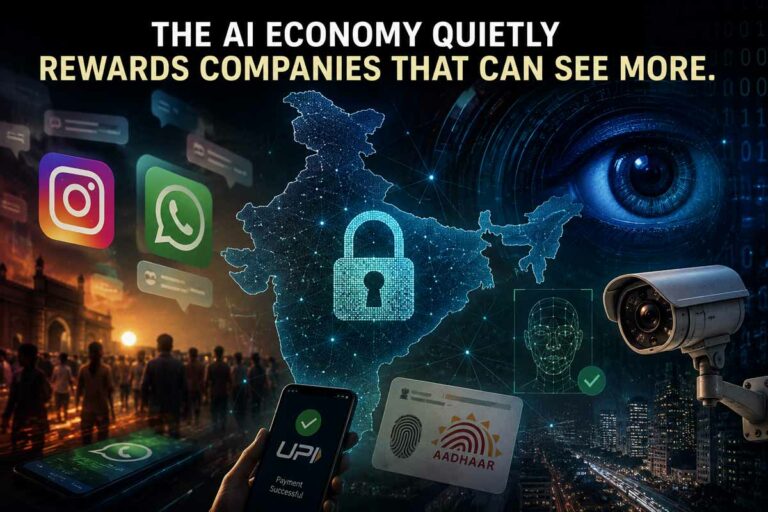
India Never Really Had a Privacy Era
Around 2019, Silicon Valley briefly convinced itself that privacy was the future. Mark Zuckerberg published his “future is private” manifesto. Apple ran billboard campaigns implying it was less a trillion-dollar corporation and more a digital rights NGO. WhatsApp wrapped end-to-end encryption in the language of personal freedom.
At the exact same moment, India was busy becoming one of the most data-rich societies on earth.
Not deliberately. Not through some grand surveillance doctrine. Mostly through convenience.
Jio’s telecom price war in 2016 pushed mobile data costs down so aggressively that India added hundreds of millions of internet users within a few years. Aadhaar scaled into the world’s largest biometric identity system. UPI transformed payments from an event into background behaviour. By 2024, NPCI’s UPI infrastructure was processing more than 13 billion monthly transactions. WhatsApp crossed roughly 535 million Indian users by 2023.
Then came DigiYatra. Facial-recognition airport entry suddenly became normal enough that most passengers now care more about whether the gate opens quickly than where their biometric data sits afterward.
India digitised before it philosophised.
Europe spent years arguing about consent frameworks, surveillance architecture and GDPR compliance. India scanned QR codes and moved on with its day. That sounds dismissive, but it also explains why the country became such fertile ground for AI-era platform economics.
Because AI systems are changing what technology companies fundamentally value.
AI Companies Don’t Just Want Data Anymore
The older internet monetised visibility in public spaces. Search histories. Facebook posts. Instagram likes. YouTube watch patterns.
That model is weakening.
Younger users increasingly treat public social media like a stage-managed performance. Real conversations migrated elsewhere years ago — private groups, DMs, close-friend’s stories, encrypted chats, locked communities. The internet did not become less expressive; it became less public.
The useful internet moved indoors.
This creates a structural problem for AI companies because large AI systems thrive on context. Emotional tone. Behavioural sequencing. Conversational patterns. Relationship dynamics. Signals around intent and uncertainty. Recommendation engines improve when they understand not merely what users consume, but how they react privately when nobody is performing for an audience.
No executive says this particularly loudly because it sounds creepy when phrased honestly. But the economics are straightforward: AI companies benefit from visibility.
Meta’s recent decision to allow Instagram to scan certain private messages for safety purposes sits inside this larger shift. Officially, the justification revolves around child protection and abuse prevention. Those concerns are real. Large encrypted ecosystems genuinely make moderation harder, especially at Indian scale where misinformation, scams and viral panic spread across dozens of languages simultaneously.
Still, it would be naïve to pretend safety is the only incentive here.
AI systems improve when platforms can observe more human behaviour with greater contextual depth. Moderation, personalization, advertising, recommendation engines and predictive systems all become more effective when blind spots shrink.
The incentives no longer point neatly toward maximal privacy.
India Is Almost Perfect for This Model
India generates astonishing amounts of behavioural data at astonishing scale.
Cheap smartphones. Low-cost internet. Integrated digital infrastructure. Massive platform dependency. A population increasingly comfortable living through apps. Together, they create conditions most AI companies find commercially irresistible.
The interesting part is that India did not arrive here through authoritarian force. Most people opted in willingly because the systems solved real problems.
UPI made transactions frictionless. Aadhaar streamlined verification. Food delivery apps became infrastructure for urban life. DigiYatra reduced airport friction enough that facial recognition started feeling less like surveillance and more like premium convenience. That psychological transition matters.
Surveillance rarely arrives looking like surveillance anymore. It arrives looking like speed.
And once convenience becomes infrastructural, resistance starts sounding inefficient. People who would passionately oppose government overreach in theory often surrender enormous amounts of data in exchange for shaving ten minutes off a process. In India, this contradiction appears everywhere. Someone deeply suspicious of tax authorities will casually upload PAN cards, selfies and contact access into a random fintech app because the onboarding bonus looked attractive at midnight.
Behaviourally, convenience keeps winning.
AI companies understand this dynamic extremely well because modern AI systems increasingly operate through inference rather than direct observation. The old fear was that companies might literally “read” private conversations. The newer reality is subtler.
Platforms often do not need exact messages. Metadata, engagement rhythms, interaction patterns and conversational context already reveal extraordinary amounts about users. AI systems care less about isolated secrets than about probabilities: who is anxious, persuadable, impulsive, politically reactive, likely to spend, likely to churn, likely to click.
Prediction scales more efficiently than surveillance.
The WhatsApp Problem Was Never Just About WhatsApp
The legal fight between WhatsApp and the Indian government over traceability rules exposed this tension years ago. Under India’s 2021 IT Rules, platforms could be required to identify the “first originator” of problematic messages. WhatsApp sued the government, arguing that traceability would undermine end-to-end encryption itself.
Privacy activists treated the issue as a civil liberties battle. The government framed it as a law-and-order necessity in a country dealing with misinformation, mob violence and financial scams spreading through viral forwarding networks.
Neither side was entirely wrong, which is what made the case uncomfortable.
India’s moderation challenges are genuinely difficult. The country’s linguistic fragmentation alone creates nightmare conditions for trust-and-safety teams. Add AI-generated misinformation, deepfake political content and industrial-scale fraud operations, and the pressure for greater visibility becomes easier to understand operationally.
According to the Indian Cyber Crime Coordination Centre, cyber fraud losses crossed ₹11,000 crores in 2024.
AI-assisted impersonation scams are rising rapidly because the ecosystem now contains enough behavioural and biometric data to imitate people convincingly.
That is the contradiction sitting underneath the entire AI economy right now.
The same visibility infrastructure that improves convenience also improves manipulation.
The same systems that reduce fraud can deepen surveillance.
The same behavioural intelligence that powers personalization can also power prediction at uncomfortable depth.
And AI companies are being economically rewarded for pushing further into that territory.
The Privacy Debate Has Already Changed
Most public conversations about privacy still operate using older internet assumptions. People imagine surveillance as a person reading chats somewhere in a dark room.
That is not how modern visibility works.
The more consequential shift is invisible accumulation — systems building increasingly accurate behavioural models from thousands of ordinary interactions spread across payments, messaging, purchases, search behaviour, location data and recommendation loops.
India may simply reach this future earlier than most countries because the infrastructure is already in place and the public tolerance for convenience-led visibility remains remarkably high.
The internet once promised users anonymity while making institutions transparent. AI may reverse that arrangement completely.
The post The AI Economy Quietly Rewards Companies That Can See More appeared first on N4M (News4masses).
from
https://news4masses.com/ai-economy-quietly-rewards-companies/




No comments:
Post a Comment